Key Takeaways
- Small fiber neuropathy (SFN) affects nerves involved in pain, temperature, and sometimes automatic body functions.
- A normal EMG does not rule out isolated SFN—and does not establish the diagnosis either.
- Skin biopsy and functional testing support a clinical diagnosis; no single result explains every symptom or identifies the cause.
- Evaluation should look for treatable contributors, including diabetes, nutritional deficiencies, and selected immune or systemic diseases.
- Treatment combines cause-directed care, individualized pain management, and support for function, sleep, and autonomic symptoms.
- IVIG is not routine treatment for idiopathic SFN. Antibody findings alone do not prove that immune therapy will help.
What Is Small Fiber Neuropathy?
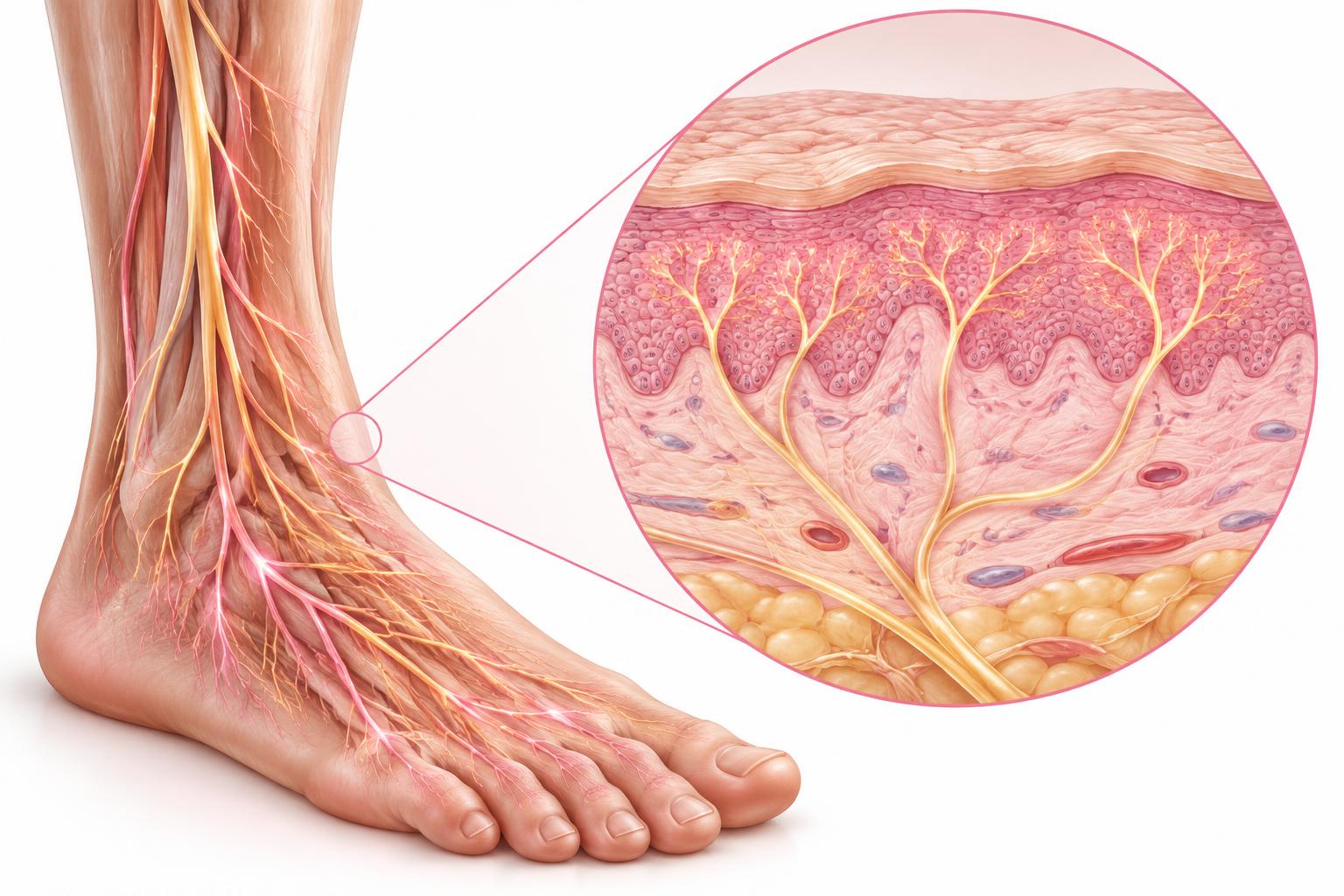
Direct answer: SFN is damage or dysfunction involving small peripheral nerve fibers. Thinly myelinated A-delta fibers and unmyelinated C fibers help carry pain and temperature signals. Autonomic small fibers help regulate sweating, blood-vessel tone, and other involuntary functions. Damage can cause painful misfiring, reduced sensation, or autonomic problems.
Large fibers do different jobs, including vibration and position sense, and motor nerves support muscle movement. In isolated SFN, strength, reflexes, and vibration sensation may be preserved. A person can therefore look well and perform many standard examination tasks while experiencing significant pain. Some people have mixed small- and large-fiber neuropathy, which changes the examination and test results. Johns Hopkins explains this distinction.
Symptoms: More Than Burning Feet
Sensory symptoms
Burning, tingling, stabbing, pinching, or electric-shock sensations may start in the toes and feet and gradually move upward. Some people notice pain from bedsheets or light touch—called allodynia—or unusual heat and cold sensitivity. Reduced pain or temperature sensation can coexist with painful sensations, so a numb area is not automatically protected from injury.
The common length-dependent pattern affects the longest nerves first. A non-length-dependent pattern can be patchy, affect the hands early, or involve the face, trunk, or proximal limbs. Widespread symptoms warrant a broader differential diagnosis; location alone cannot establish SFN. Isolated back pain is not enough to diagnose it.
Autonomic symptoms
When autonomic fibers are involved, symptoms may include abnormal sweating, heat intolerance, lightheadedness on standing, palpitations, digestive changes, or bladder and sexual-function symptoms. The exact pattern varies. SFN does not cause every episode of dizziness, constipation, or racing heart, and sensory-only SFN may have none of these features.
Fatigue and brain fog may accompany pain, poor sleep, autonomic symptoms, or an underlying illness. They are nonspecific, not diagnostic signs of SFN. Likewise, POTS can coexist with small-fiber dysfunction in a subset of people, but POTS is not synonymous with SFN. Read more about other causes of persistent fatigue.
Why Small Fiber Neuropathy Is Hard to Diagnose—and Easily Missed
1. The common tests examine different nerves
Nerve conduction studies measure signals in large fibers; needle EMG examines electrical activity in muscle and can help identify motor nerve or nerve-root problems. Routine electrodiagnostic testing does not directly measure small pain and temperature fibers. Results may therefore be normal in isolated SFN. These tests remain useful for identifying a different disorder or additional large-fiber involvement.
2. The examination may look reassuring
Normal strength and reflexes are compatible with isolated small-fiber disease. Subtle pinprick or temperature changes may be more informative, but early disease can be difficult to detect. A normal examination cannot be interpreted separately from the history.
3. Symptoms overlap with many conditions
Nerve entrapment, radiculopathy, other neuropathies, medication effects, vascular conditions, and some central nervous system disorders can produce similar sensations. Fibromyalgia and SFN are not interchangeable diagnoses; small-fiber abnormalities have been reported in some fibromyalgia research, but that does not mean every person with widespread pain has SFN.
4. Specialized tests have real limitations
Biopsy samples a small area, and patchy or early involvement may not be captured. Functional abnormalities and structural nerve loss do not always appear together. Access to autonomic laboratories, validated biopsy processing, and specialist interpretation can also be limited.
5. Physical symptoms and distress get separated
A racing heart, sweating, and poor sleep can resemble anxiety, while persistent pain can worsen anxiety and depression. Neither possibility cancels the other. A careful evaluation avoids both dismissing physical symptoms and declaring SFN without enough evidence. This is the same whole-picture approach discussed in mental health and chronic illness.
How Is Small Fiber Neuropathy Diagnosed?
Direct answer: diagnosis combines the history, examination, appropriate testing, and assessment of alternative causes. There is no universally perfect test. A neurologist may use a skin biopsy, autonomic testing, or sensory testing depending on the presentation and local availability.
| Evaluation | What it helps assess | What it cannot settle alone |
|---|---|---|
| History and examination | Pain and temperature sensation, distribution, strength, reflexes, and autonomic clues | Findings can be subtle; symptoms overlap with other conditions |
| EMG / nerve conduction studies | Large-fiber, motor, muscle, or nerve-root problems | Often normal in isolated SFN; not a direct small-fiber test |
| Skin punch biopsy | Intraepidermal nerve fiber density at a sampled site | A structural test; sampling and reference ranges matter; does not identify the cause |
| QSART / autonomic testing | Sweat-related nerve function; other tests assess heart-rate and blood-pressure responses | Not universally available; medicines and testing conditions can affect results |
| Quantitative sensory testing (QST) | Detection thresholds for warmth, cold, or pain | Depends on attention and response; cannot reliably localize peripheral versus central causes alone |
| Blood tests | Treatable metabolic, nutritional, immune, or systemic contributors | Normal blood work does not exclude SFN; abnormal results need interpretation |
What happens during a skin punch biopsy?
A small sample—commonly a 3 mm punch—is taken after local anesthetic, often from the lower leg and sometimes another site to assess distribution. The injection can sting; pressure or brief discomfort and minor wound care are possible. It is usually well tolerated, but should not be described as literally painless.
The laboratory compares intraepidermal nerve fiber density (IENFD) with validated reference values. Reduced density supports small-fiber loss in the appropriate clinical setting. It does not identify why the nerves were injured, measure pain severity directly, or prove that every symptom comes from neuropathy. A normal biopsy can leave questions unresolved.
When do QSART, autonomic testing, or QST help?
QSART—quantitative sudomotor axon reflex testing—assesses sweat responses mediated by small autonomic fibers. Heart-rate responses to breathing, Valsalva testing, or tilt-table testing may be considered for particular autonomic symptoms; these tests answer different questions. A tilt-table result by itself is not a diagnosis of SFN.
QST evaluates thresholds for temperature or pain detection, but depends on the person's responses and can reflect central as well as peripheral factors. Complementary tests sometimes improve diagnostic confidence. Ask the testing center how medications, caffeine, nicotine, and skin products may affect preparation; do not stop prescribed medication without instructions. The CCJM clinical review describes this approach.
Looking for the Cause: What Blood Work and History May Reveal
Diabetes is an important identifiable cause. Impaired glucose tolerance is also considered, although its causal role is not settled in every patient. Depending on the history, testing may include glucose or A1c, sometimes an oral glucose tolerance test, B12 with additional confirmation when indicated, thyroid function, blood count, and kidney or liver assessment.
Selected evaluation may investigate Sjögren disease, celiac disease, other inflammatory disorders, HIV or hepatitis C, or abnormal blood proteins. Dry eyes and mouth, joint symptoms, rashes, gastrointestinal symptoms, family history, and the distribution of nerve symptoms help guide that workup. Not every patient needs every autoimmune panel.
Alcohol exposure, chemotherapy, and other medication or toxin exposures matter. Excess vitamin B6 can itself cause neuropathy, so taking a high-dose “nerve health” supplement without checking its ingredients can be harmful. Genetic testing or evaluation for amyloidosis and other uncommon causes is reserved for suggestive histories and examination findings.
Some cases remain idiopathic—no cause is identified despite a reasonable evaluation. That does not mean symptoms are imagined, nor does it prove an autoimmune cause. A mildly abnormal lab or positive antibody needs clinical interpretation. Related reading: Hashimoto's and overlapping fatigue or mood symptoms and evaluating chronic illness and autoimmune concerns.
Small Fiber Neuropathy Treatment Options
Treatment has two parallel aims: address an underlying cause when possible and reduce symptoms enough to support daily life. Pain medication does not establish the diagnosis, and relief does not necessarily mean nerves have recovered. Evidence for medication choice comes largely from broader neuropathic pain studies rather than large trials in every SFN subtype.
| Option | Potential role | Tradeoffs to discuss |
|---|---|---|
| Treat an identified cause | Glucose management, B12 replacement when deficient, or disease-specific treatment | A cause-directed plan is different from simply suppressing pain; avoid unneeded supplements |
| Duloxetine and other selected SNRIs | Neuropathic pain, sometimes alongside depression or anxiety | Nausea, blood-pressure effects, interactions, and discontinuation symptoms; suitability varies |
| Gabapentin / pregabalin | Reduce nerve-related pain and sometimes help disrupted sleep | Sedation, dizziness, swelling; kidney-based dosing and caution with opioids or sedatives |
| Amitriptyline / nortriptyline | Selected patients with pain and sleep disruption | Dry mouth, constipation, urinary retention, rhythm issues, and standing dizziness; not a gentle fit for everyone |
| Topical lidocaine / capsaicin | Localized painful areas with less systemic exposure | Skin irritation; high-concentration capsaicin is clinician-administered; protect numb skin |
| Rehabilitation and pain support | Function, pacing, balance when needed, sleep, and coping with persistent pain | Adjunctive support, not evidence the pain is imagined or a replacement for investigating the cause |
Why low-dose amitriptyline is not the answer for everyone
A tricyclic antidepressant can help neuropathic pain even when depression is not present. But “low dose” does not remove anticholinergic, cardiac, or blood-pressure effects. Constipation, urinary problems, orthostatic dizziness, rhythm concerns, and other medications may make a different option preferable. Nortriptyline is sometimes better tolerated, but still needs individualized assessment.
Autonomic symptoms need their own plan
Management depends on whether the problem is low standing blood pressure, heart-rate changes, sweating, gastrointestinal motility, or another issue. Hydration, compression, activity modification, and targeted medication may help selected patients. Increasing salt or fluids is not universally safe with kidney disease, heart disease, or hypertension; seek individual guidance rather than following a blanket dysautonomia protocol.
What about IVIG, steroids, and immune treatment?
These are not routine treatments for unexplained burning pain or idiopathic SFN. The 2023 AANEM consensus recommends against IVIG for idiopathic SFN and for SFN associated with TS-HDS or FGFR3 antibodies, based on available trial evidence. IVIG also has significant cost and risks, including infusion reactions and, less commonly, clotting or kidney complications.
An independently established inflammatory or autoimmune disease may require disease-specific treatment under a neurologist or rheumatologist. That is different from assuming that an antibody result alone makes SFN immune-responsive. Steroids and immune therapies require a defined indication and monitoring.
Protecting Function, Sleep, and Mental Health
Protect areas with reduced sensation: check feet for sores, choose comfortable footwear, and avoid heating pads or very hot water on numb skin. Activity pacing and a manageable exercise plan can help maintain function without repeatedly pushing through flares. Occupational or physical therapy may be useful for individual functional goals.
Pain and fragmented sleep can amplify each other. A pain diary can track location, triggers, sleep, function, and medication effects, making follow-up more concrete. Pain-focused psychological support can improve coping and function without implying that nerve symptoms are psychological.
If both neuropathic pain and mood symptoms are being treated, review the whole medication list rather than adding sedating medicines independently. For example, a medication that helps pain may also affect mood, blood pressure, or sleep. Coordination matters, as explained in connecting chronic illness care and mental health treatment.
Can Small Fiber Neuropathy Improve?
The course depends on the cause, duration, and extent of injury. Treating a nutritional deficiency or metabolic contributor may allow improvement or prevent additional damage, but symptoms may persist and recovery can take time. Some people remain stable; others develop additional nerve involvement. There is no universal recovery timeline or supplement that reliably reverses all SFN.
Follow-up should consider function as well as pain: walking, sleep, work, daily activities, and side effects. New weakness, loss of balance, or changing examination findings may mean the condition is no longer isolated SFN—or that a different diagnosis needs attention.
When to Seek Urgent Medical Care
Do not assume sudden or rapidly worsening symptoms are an ordinary neuropathy flare. Seek prompt assessment for new weakness, worsening falls, spreading numbness, recurrent fainting, or substantial new bowel or bladder problems.
Call 911 for sudden one-sided weakness, severe breathing difficulty, or fainting with chest pain. New loss of bladder or bowel control with severe back pain or saddle-area numbness needs emergency assessment. These are not typical features to explain away as isolated SFN.
Questions to Bring to a Neurology Appointment
- Does my pattern fit small-fiber disease, or are nerve-root, large-fiber, or other causes more likely?
- What did my EMG rule out—and what did it not test?
- Would biopsy, QSART, or another test change the treatment plan?
- If a biopsy is normal, what would the next reasonable step be?
- Which treatable causes fit my history, and which tests are unnecessary?
- Could any medication or supplement worsen my symptoms or interfere with testing?
- Which pain option best fits my kidney function, heart history, standing symptoms, and sleep?
- How will we measure improvement, and which new symptoms require earlier follow-up?
Frequently Asked Questions
Coordinating Care for the Whole Picture
Christine can help discuss overlapping mood, sleep, and chronic-health concerns within the practice's services and coordinate appropriate specialist care. Skin biopsy and specialized autonomic testing generally require a neurology referral or testing center; this page does not advertise those tests as services performed by Christine. Review chronic-health gap care for service fit. Telehealth is available in Florida, Wisconsin, and Nevada; this practice does not prescribe controlled substances in Nevada.
Discuss Care OptionsSources and Further Reading
- Johns Hopkins: small fiber sensory neuropathy
- Cleveland Clinic: symptoms, causes, and treatment
- Cleveland Clinic Journal of Medicine: Office approach to small fiber neuropathy
- JAMA Neurology: scientific advances and clinical approaches to small-fiber polyneuropathy
- QSART study: contribution of sudomotor testing to SFN diagnosis
- AANEM 2023 consensus: IVIG in neuromuscular disorders
Sources reviewed October 15, 2026. Testing availability and treatment recommendations may evolve.
Medical disclaimer: General education only; not a diagnosis or individualized treatment advice. Do not start, stop, or change medication or supplements based on this article. A neurologist should interpret specialized testing. Seek emergency care for acute neurologic or other serious medical symptoms.
Related Articles
LDN + Amitriptyline 10 mg: Chronic Pain, Inflammation & Fatigue
Combination rationale, mixed LDN evidence, low-dose pain treatment, and precautions for fatigue, opioids, and side effects.
Read MoreFDA-approved for depression at 75–150 mg, but most prescriptions today are low-dose off-label uses for nerve pain, migraines, fibromyalgia, and sleep.
Read MoreA non-controlled, fast-acting anxiety option — how it works, typical dosing, what to watch for, and where it fits alongside SSRIs.
Read More